
Restore Allen brought together 55 leaders from Allen County’s justice system and community organizations in a five-month discovery process that led to 17 recommendations across five focus areas.

BUILDING CAPABILITY FROM WITHIN
Industries change gradually, then all at once. Technology advances. Expectations shift. Categories evolve. Across the enterprise, platforms build capability and put it to work as changing conditions emerge. Over the past year, leadership has advanced this work through the development of systems that govern performance, launching a new brand in an adjacent market, and direct investment in construction automation.
OWNING THE EXECUTION LAYER
Datum, powered by DCS, SOLV Holdings
As warehouse systems have grown more complex, the software that governs performance has become increasingly consequential. The logic that prioritizes movement, manages congestion, and reconciles exceptions now determines how entire facilities operate.
 At Designed Conveyor Systems (DCS), leadership determined that logic belonged inside its direct authority. Matt Ferguson, President of DCS, put it simply: “There are layers of a system you can outsource, and layers you shouldn’t. We decided the execution layer was one we needed to own.”
To carry out the work, DCS brought in software expertise to augment its team and, alongside its engineers, built its execution platform, Datum. The team began by writing the system logic themselves—defining how systems respond, how decisions are made, and how rules are applied—then carried that logic into operating environments.
Originally unveiled at ProMat 2023, Datum has become part of how DCS delivers the execution layer in operating facilities—built on the same engineering standards that shape the rest of its work.
BRINGING ITS ENGINEERING DISCPLINE INTO A NEW MARKET
Revel, Correct Craft
In the recreational marine market, pontoon boats have long been built around stability and leisure. Correct Craft set out to bring its engineering discipline into a segment where meaningful innovation had been scarce for decades.
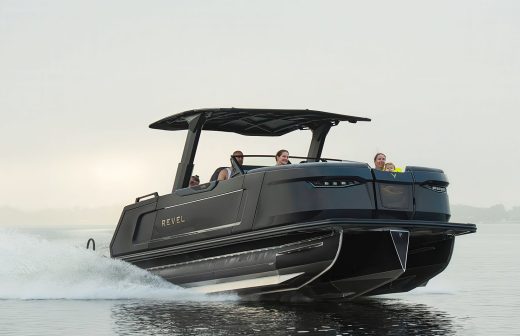 That effort became Revel, a brand built from the ground up. It carried expectations shaped by Correct Craft’s towboat brands into a space with different priorities, starting with performance, design, and manufacturing-control standards. Correct Craft announced its launch in April 2025.
Bill Yeargin, CEO of Correct Craft, tied the decision to the company’s mission: “Our focus has always been about ‘making life better’ for our customers, our people, and our communities…Revel gives us an opportunity to bring that same spirit to the pontoon market.”
What began as a technical exploration quickly evolved into a broader push to rethink what a pontoon could be. It drew on disciplines already proven elsewhere in the enterprise, from running-surface engineering to manufacturing control. From CAD, the team moved to prototypes—built, tested, reworked, and retested.
With Revel’s launch, Correct Craft brings its core disciplines into the market—setting a new reference point for what pontoon boats can be.
BRINGING ITS ENGINEERING DISCPLINE INTO A NEW MARKET
Rival Lab, Rival Holdings
Industrialized construction is transitioning from vision to operating reality. Advanced automation and robotic micro-factories are beginning to enter homebuilding. Amid that shift, Rival Holdings established Rival Lab as a place to test and learn in real-world conditions.
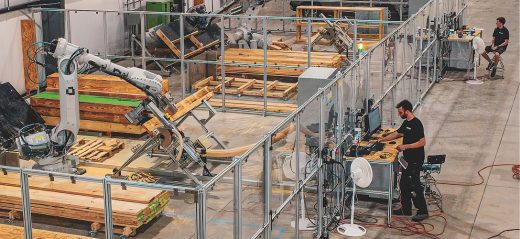 Rival Lab was established as a dedicated innovation arm, led by Jerod Hevel, VP of Innovation and Strategy, and Brad Crawford, CEO. From the start, it was designed as a living laboratory—testing emerging automation in operating conditions and learning what it demands of people, workflow, and day-to-day execution.
An early initiative was an investment in and partnership with Automated Architecture (AUAR), a company developing robotic micro-factories for timber-based housing. In 2024, Rival served as the exclusive deployment partner for AUAR’s first U.S. rollout, bringing micro-factories into the Midwest and into Rival’s operating environment.
Crawford explains, “To shape the future of homebuilding, we must operate automation ourselves—long enough to master what succeeds, what fails, and what it truly takes to deliver reliably at scale.”